
When a tooth goes missing—after an extraction, an accident, or years of patching a failing one—the gap is rarely just cosmetic. Chewing quietly shifts to one side, and neighboring teeth begin to drift into the space. According to the American Dental Association (ADA) MouthHealthy overview of dental implants, adults commonly face decayed or missing teeth, and leaving a gap open for months can change chewing, speech, and facial support. Comparing replacement paths early is a clinical decision, not a cosmetic afterthought. (General education only—your exam and imaging decide what applies.)
At Trust Dental Care in Tijuana, planning starts with imaging and a written restorative sequence under Dr. Cirenia Aparicio Miranda, DDS. This guide compares three paths for a single missing tooth or short gap—a dental implant with a crown, a conventional dental bridge, and a removable partial—so you can walk into a consultation already knowing the tradeoffs. Full-arch and implant-supported packages belong in our five tooth replacement paths (including implant-supported dentures)—not as a fourth “single-tooth” default here.
How do clinicians choose among single-tooth options?
Clinicians weigh five factors before recommending anything: whether the neighboring teeth are healthy enough to support a bridge, bone volume and gum health if an implant is considered, medical factors that affect healing, whether you prefer a fixed or removable appliance, and how you want to clean around the restoration long term. Replacement is a restorative decision, not a product upsell.
Internal planning at Trust Dental Care follows a clear clinical sequence:
- Clinical exam & imaging: Clinical exam plus radiographic review (often CBCT when implants are considered) to assess bone volume and site readiness.
- Bite & smile evaluation: Check bite, smile goals, and whether a fixed or removable path fits neighboring teeth and preferences.
- Sequenced treatment letter: Written plan that separates surgical steps from prosthetic fees against the published fee list.
- Maintenance recall: Schedule professional checks and home-care expectations for the chosen restoration.
If several teeth are missing and the face looks collapsed or “sunken,” read our related guide on how multiple missing teeth affect facial support, then return here for single-gap tradeoffs—or open the five-path guide when full-arch planning is on the table.
How do the three options compare side by side?
The table below lines up the three paths on the factors patients ask about most: surgery level, effect on neighboring teeth, daily maintenance, and the published fee-list anchor.
| Option | Best when | Surgery level | Effect on neighbors | Maintenance | Fee-list anchor (Tijuana) |
|---|---|---|---|---|---|
| Dental implant + crown | Single tooth (or spaced gaps); adequate bone or graft plan | Surgical placement + healing | Usually none prepared | Brush/floss like a tooth; professional checks | Placement from $799; abutment/crown listed separately |
| Dental bridge | Healthy teeth on both sides of a short gap; implant not indicated | Typically no implant surgery | Abutment teeth crowned | Floss threaders / careful hygiene under pontic | Dental bridges from $1,950 |
| Removable partial | Single/short gaps when fixed options are deferred; interim during healing | Non-surgical | Clasps may engage neighbors | Daily removal and cleaning | Partial from $499 (full-arch packages → five-path guide) |
Figures are published line items on our dental prices in Tijuana page and can change; your written plan lists what is included for your smile.
When is a dental implant the right choice?
A dental implant is usually the first option evaluated when you want a fixed tooth that does not rely on neighboring enamel for support, and when bone and general health allow surgical placement. The implant replaces the root with a biocompatible fixture (commonly titanium) placed in the jaw; after healing, an abutment and crown restore the visible tooth.
Materials (brief): a fixture (often titanium), an abutment, and a ceramic or zirconia crown depending on esthetic and bite needs. Placement-only is not the same as a finished tooth. On our fee list, implant placement starts at $799, with abutment and implant crown listed as separate items (for example abutment $399 and implant crown $650 on the published list). Promo “full dental implant” cards on the fee page are labeled separately from placement-only—read the line item before you travel so you are not comparing a fixture fee to a U.S. quote that already bundles the crown.
Clinical notes: Implants usually avoid reshaping adjacent healthy teeth. They require enough bone or a grafting plan, medical clearance when indicated, and weeks to months of healing in many protocols. Selected cases may use accelerated or same-day prosthetic workflows, but that is not universal and should be confirmed in writing. Longevity depends on hygiene, bite forces, systemic health, and maintenance visits—not on a marketing promise.
Does implant placement hurt?
Most patients report that the placement appointment feels easier than they expected. Modern implant surgery is performed with local anesthesia, and the days after are usually described as soreness managed with common medication rather than sharp pain. In many cases, the anxiety before the visit turns out to be the hardest part of the appointment. If dental anxiety is a real obstacle for you, mention it when you write—sedation options can be discussed as part of the written plan, so comfort is decided before you travel, not in the chair.

Explore our dental implants in Tijuana hub for procedure depth. Full-arch needs (All-on-4 / All-on-6 / All-on-8) are different packages on the fee list—see the five-path guide rather than treating them as a single-tooth quote.
When does a dental bridge make more sense?
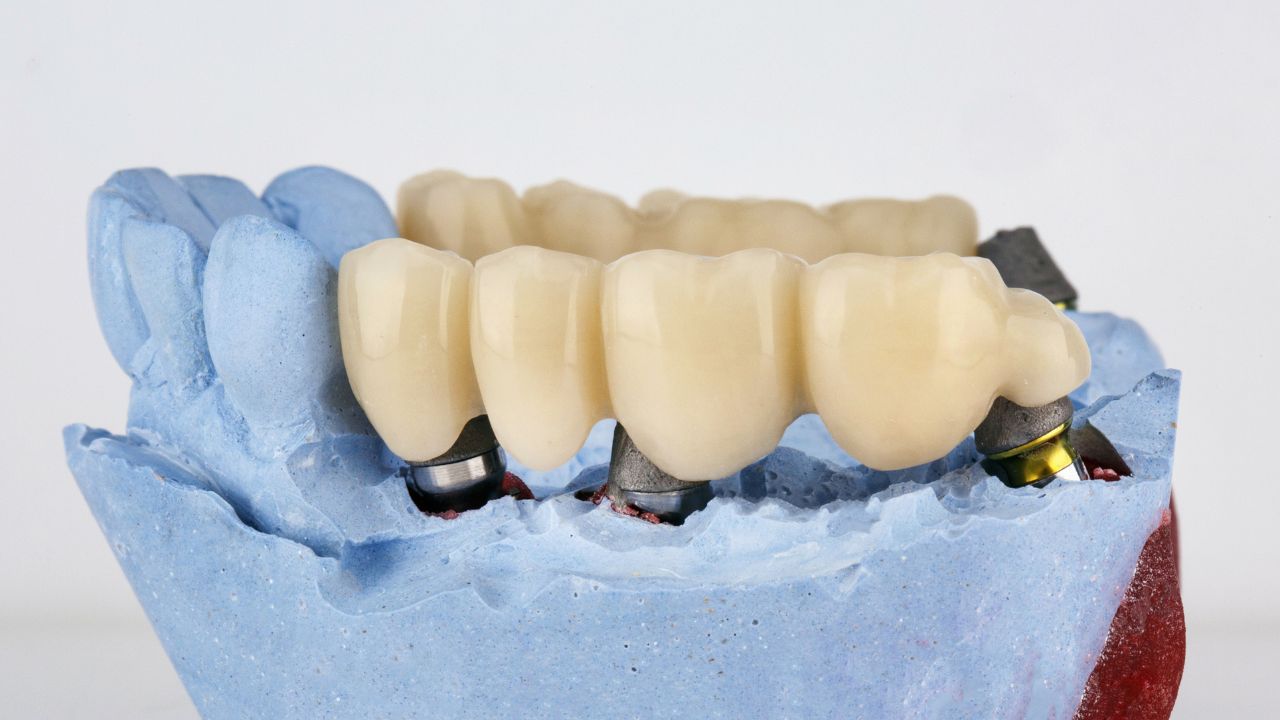
A conventional bridge often makes sense when the teeth on both sides of a short gap are already strong candidates for crowns, or when implant surgery is deferred for medical, anatomic, or timeline reasons. A bridge uses crowns on those neighboring teeth (abutments) to hold a pontic—the replacement tooth—in between. It is fixed, so you do not remove it daily, and it can restore esthetics and chewing on a shorter timeline than many implant sequences.
Advantages (case-dependent): fixed function compared with a removable partial; typically fewer surgical steps than implants.
Tradeoffs: Abutment teeth must be prepared for crowns; cleaning under the pontic takes extra tools and discipline; bone under a pontic does not receive implant-style loading; bridges may need replacement over a span of years depending on hygiene, decay risk, and bite. A commonly discussed clinical range is roughly four to ten years before a bridge may need remake—your dentist should individualize that outlook rather than treat it as a guarantee. Published fee-list bridges start from $1,950; confirm how many units and which materials appear in your plan. See dental bridges in Tijuana for service detail.
When is a removable partial a practical option?
A removable partial is a practical path when fixed options are deferred, when an implant is healing, or when surgery is simply not your preference. It fills a single tooth or short gap while using remaining teeth for support or retention, and on our fee list a removable partial denture is listed at $499.
Some patients notice more movement than with fixed implants or bridges, especially with advanced ridge resorption, and clasps may engage neighboring teeth. For many people, though, a partial is the difference between hiding a gap this year and restoring it on a realistic budget and timeline. Full dentures and implant-supported overdentures are separate pathways—compare them in the five tooth replacement paths guide rather than treating All-on packages as a fourth single-tooth option here.
What happens if a missing tooth is not replaced?
It is easy to assume a gap can wait because it does not hurt. Unfortunately, bone and neighboring teeth respond to the absence, not to the pain. When a tooth is missing, the jawbone in that area no longer receives chewing stimulation and can gradually lose volume—a process called resorption. Teeth next to the gap may drift or tilt into the space, and the opposing tooth can over-erupt, slowly changing the way your bite fits together.
Over months and years, these shifts can make future replacement more complex: less bone for an implant, less room for a bridge, more movement to correct first. Replacing a single tooth early is usually simpler than rebuilding a collapsed bite later—which is why “I’ll deal with it eventually” often becomes the most expensive option on this page.
How do U.S. dental costs compare to Tijuana fee-list ranges?
The honest answer is that U.S. quotes vary widely by city, material, grafting, sedation, and whether temporary teeth are included—so any out-of-state number should be treated as a personal quote to verify, not a universal sticker price. Patients often tell us implant care feels expensive in the United States or Canada and that dental benefits may cover only part of surgical or prosthetic fees. Be cautious with marketing that sells “guaranteed” percentage savings; transparent comparison works better.
For that comparison on our side, use labeled Tijuana fee-list ranges and ask which line items your smile requires.
| Line item (fee list) | Published anchor |
|---|---|
| Dental implant (placement only) | Listed at $799 |
| Implant abutment | Listed at $399 |
| Implant crown | Listed at $650 |
| Dental bridges | From $1,950 |
| Removable partial denture | Listed at $499 |
| Full-arch packages (All-on-4 / 6 / 8) | See five-path guide + fee list ($10,499 / $13,499 / $15,699) |
Always re-check the live fee list before booking travel. Bring recent radiographs when you can; if new imaging is needed, that step belongs in the written sequence so fees stay predictable.
How do you care for your chosen replacement?
Whichever path you choose, daily cleaning is what protects the investment: brush and clean between teeth—or under pontics and around implant restorations—every day. Keep professional exams on the schedule your dentist recommends; many stable patients return about twice yearly. Missing-tooth replacement can improve comfort and confidence, but outcomes still depend on home care, night guards when grinding is present, and follow-up adjustments.
If something feels off after treatment—a high bite, a loose clasp, bleeding around a crown—do not wait for the next scheduled visit. Small adjustments are routine; ignored ones become repairs.
How do you plan treatment from the San Diego area?
Cross-border patients usually start without traveling: send photos or recent X-rays, and the team maps implant, bridge, or partial options to your actual gap before any appointment is booked. You receive a written sequence that separates surgical steps from prosthetic fees, so the plan you approve at home is the plan that greets you at the clinic—minutes from the San Diego border corridor, with English-speaking coordinators and guidance on crossing and transportation.
When you are ready, contact our Tijuana team with your questions or imaging. A personalized sequence built on your real X-rays will always beat a generic slogan—and it starts with one message.