
Search for the average cost of a dental implant and you will find numbers that range so widely they are almost useless — because an “average” blends single-tooth cases with full-arch reconstructions, placement-only prices with complete packages, and practices with very different overhead. This guide separates those layers: what an implant quote actually contains, how U.S. averages compare with a published fee list in Tijuana, and how to compare two quotes that were built differently.
What Does the “Average Cost” of a Dental Implant Actually Include?
The average cost of a dental implant includes three parts: fixture, abutment, and crown. The implant fixture is the titanium post placed in the bone. The abutment connects the fixture to the restoration. The crown is the visible tooth you chew with. Some quotes bundle all three; others advertise only the fixture. When a survey reports an “average cost,” it rarely says which model the respondents used, which is why national averages should be treated as orientation, not as a benchmark for your case.
The practical fix is simple: whenever you see a price — in an article, an ad, or a treatment plan — ask whether it is placement-only or a complete package before comparing it to anything else.
Average Cost in the United States vs. Tijuana
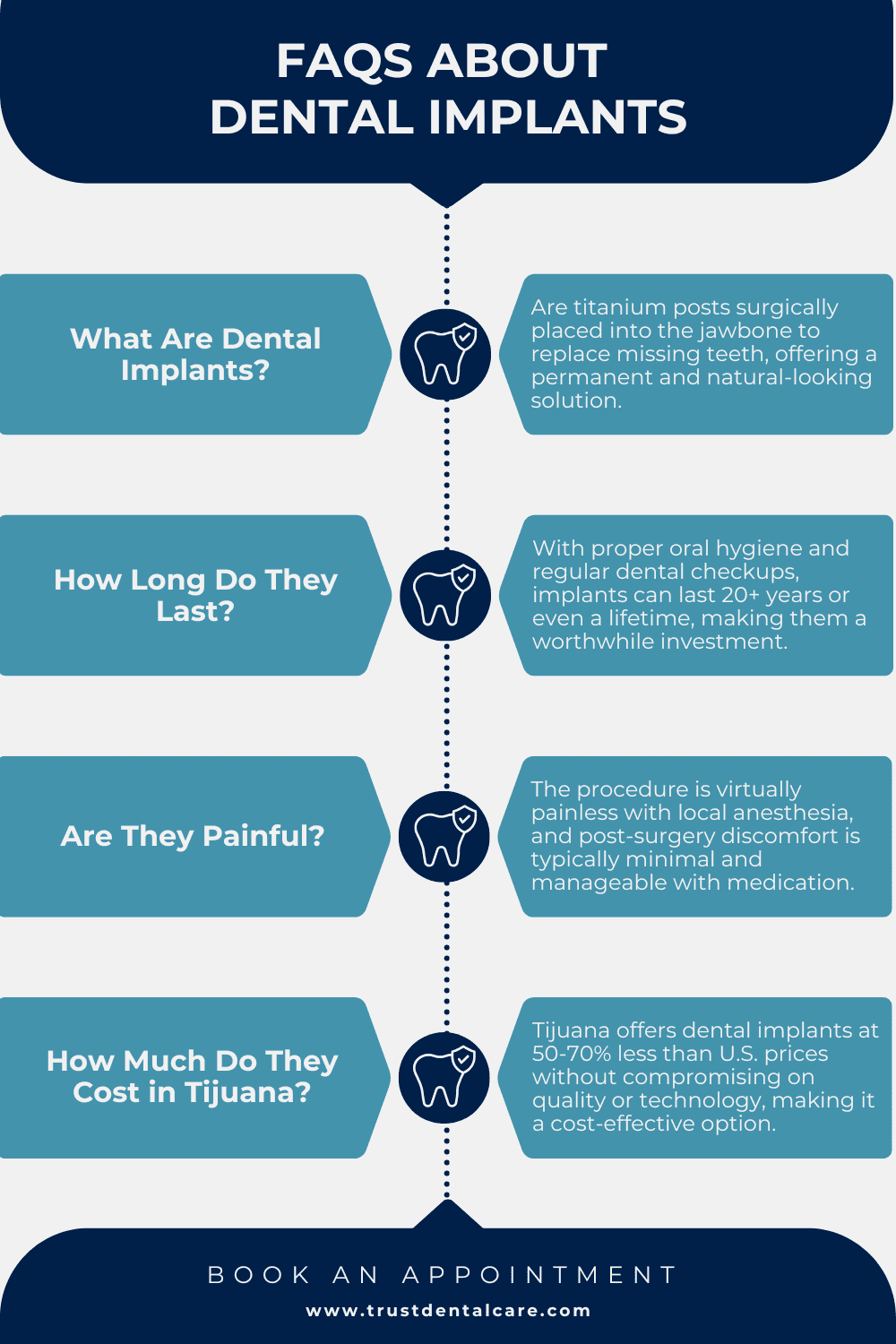
A dental implant usually costs several times more in the United States, especially in California metros, and full-arch quotes are higher still. At Trust Dental Care in Tijuana, the same components are published on an open fee list:
| Treatment | Trust Dental Care fee list | Typical U.S. quote |
|---|---|---|
| Implant placement only | from $799 | Usually higher; varies by practice |
| Full dental implant | from $1,999 | Usually higher; varies by practice |
| 4 implants, placement only | from $3,196 | Usually higher; varies by practice |
| All-on-4 complete package (per arch) | from $10,499 | Usually higher; varies by practice |
| All-on-6 complete package (per arch) | from $13,499 | Usually higher; varies by practice |
| Bone graft (when clinically needed) | from $399 | Usually higher; varies by practice |
U.S. prices vary widely by practice and are not quoted here. Each implant fee above comes from the Trust Dental Care fee list and is confirmed in your written treatment plan before any work begins.
Why Does the Same Treatment Cost More in the United States?
The same treatment costs more in the United States mainly because of operating costs. Rent, staff salaries, laboratory fees, malpractice insurance, and regulatory overhead are all higher for a U.S. practice, and those costs land in the fee schedule. The clinical inputs — implant systems, imaging technology, restorative materials — are internationally traded goods available to clinics on both sides of the border. A lower price in Tijuana reflects lower operating costs, not necessarily different materials. That is why the meaningful comparison is not “U.S. vs. Mexico” but “this clinic’s documented process vs. that clinic’s,” wherever each one is located.
Implants vs. Bridges and Dentures: Cost Over Time
Implants cost more upfront than a bridge or a removable denture, which is why averages alone push some patients toward the cheaper option. The longer view is different: a traditional bridge requires preparing the neighboring teeth and typically needs replacement within 10 to 15 years, while an implant preserves bone and does not involve adjacent teeth. Over a 20-year horizon, a single implant that is never replaced can cost less than a bridge that is remade twice. The right choice is clinical first — but the long-term math belongs in the decision.
How Long Does a Dental Implant Last?
A dental implant is a long-term restoration, and its crown is the part replaced first. The crown on top often needs replacing after 10 to 15 years. Durability is the other half of the cost equation: the fixture is often never replaced, and the crown’s lifespan depends on material and bite forces. When you amortize the complete package over that service life, the annual cost of an implant routinely beats options that were cheaper on day one but need repeating.
For what to ask before treatment, see the FDA’s Dental Implants: What You Should Know and the ADA’s MouthHealthy guide to implants.
How Many Visits Does Treatment Require?
Dental implant treatment requires two phases of visits: placement, then the final crown. The first visit covers diagnosis, imaging, and placement of the fixture; the second, after a healing period set in your written plan, delivers the abutment and final crown. For patients traveling to Tijuana from San Diego, that usually means separate round trips rather than one long stay — an important line item when you build the real total cost of a cross-border quote.
What Should a Complete Implant Package Include?
A complete implant package should include diagnosis, imaging, the implant, abutment, crown, and lab work. Whatever the country, ask for each item in writing:
- Diagnosis and imaging — clinical exam and the imaging your case needs for planning.
- The surgical phase — implant placement, anesthesia, and the fixture, with the brand identified.
- The prosthetic phase — abutment and final crown or prosthesis in the agreed material.
- Laboratory work — fabrication of the restoration, and whether the lab fee is inside the package.
- Contingencies — extractions or grafting quoted separately and upfront when indicated.
- Aftercare — post-operative checks and the follow-up terms that apply once you are home.
How to Compare Two Implant Quotes Fairly
- Confirm each quote is the same type: placement-only vs. complete package.
- Ask which implant brand and crown material each price assumes.
- Check whether imaging, temporaries, and follow-up visits are inside the number.
- Add travel costs to the lower quote before concluding it is cheaper — for cross-border cases, transportation and lodging are part of the real total.
- Get both quotes in writing. A clinic that hesitates to itemize is telling you something.
Payment and Insurance Options
Payment at Trust Dental Care is accepted in cash, Visa, Mastercard, and American Express, and the team helps file claims with PPO plans such as Delta, Cigna, Aetna, and MetLife. Itemized receipts in English are available for patients who submit out-of-network claims to U.S. insurers. Whichever way you pay, ask for the full fee in writing before treatment.
The Bottom Line
There is no single average cost of a dental implant — there is your case, quoted completely, by a clinic that documents its process. Trust Dental Care is located in Tijuana’s Zona Río, close to the U.S.–Mexico border and minutes from the San Ysidro crossing, and publishes its fees openly so the comparison is yours to make. For Tijuana-specific pricing and trip planning, see the dental implant cost guide for Tijuana, or request a written quote.