
While the entire dental implant healing process takes several months, the first 24 to 72 hours are without a doubt the most critical. Think of it as the foundation for your entire smile journey. How you care for yourself in these first few days directly sets the stage for a smooth, successful recovery. The main goal here is simple: protect the surgical site and let your body do its natural work.
The minute your procedure is finished, your body kicks into high gear to start healing. This initial 72-hour window is arguably the most vital part of your recovery, whether you’ve just received a single implant or a more complex treatment like All on 4 dental implants. The care you provide now has a massive impact on the long-term success of your investment.
Imagine the surgical area is like freshly poured concrete—it needs time to set without being disturbed. Your top priority is to protect the blood clot that forms over the implant. This clot is nature’s perfect bandage, shielding the delicate area from bacteria and creating the framework for new tissue to grow.
It’s totally normal to experience a few predictable side effects after the procedure. A good Mexico dentist will walk you through detailed post-op instructions, but knowing what’s coming can help ease any anxiety.
To make things easier, here’s a quick-reference table for navigating those crucial first three days. Following these guidelines is your best bet for a complication-free recovery.
| Timeframe | What to Expect | Key Actions to Take |
|---|---|---|
| First 24 Hours | Minor oozing, peak numbness wearing off, initial discomfort. | Rest completely. Gently bite on gauze to control bleeding. Apply ice packs for 20 mins on, 20 mins off. Take pain medication as prescribed. |
| 24-48 Hours | Swelling may increase. Discomfort should be manageable with medication. | Continue with ice packs and rest. Stick to soft, cool foods like yogurt or smoothies. Avoid hot liquids. |
| 48-72 Hours | Swelling peaks and begins to subside. Bruising may appear. | Transition to warm (not hot) soft foods. Start gentle warm salt water rinses if your dentist advised it. Continue to avoid straws and smoking. |
Think of this checklist as your roadmap to getting through the most sensitive part of the healing process.
To give your implant the best chance of success, you absolutely have to follow a few ground rules. These steps are non-negotiable for preventing issues like infection or the implant failing to integrate.
Do:
Don’t:
By managing this short period carefully, you’re creating the perfect environment for your dental implants to start bonding with your jawbone. These first few days are a small hurdle on the path to a lifetime of confident smiles. For a broader look at the entire process, feel free to check out our complete guide on everything you need to know about dental implants.
Once you’ve made it through those critical first few days, you’re officially entering the next phase of your dental implant healing timeline. For the first two weeks, your body’s energy shifts from damage control to actively healing the soft tissue around your new implant. You’ll start to see real progress as the initial swelling and bruising finally begin to subside.
Think of it like this: the heavy digging and planting are done, and now you’re just nurturing the garden. The incision from the surgery will start to knit itself closed, and your gums will begin to form a tight, protective seal around the implant post. This is a crucial step to keep bacteria out.
It’s completely normal to be a little obsessive about checking on the surgical site. A quick, gentle look can give you a lot of peace of mind. Here’s what you want to see:
This is your body hard at work regenerating those soft tissues. It’s an absolutely essential stage that creates the foundation for the deeper bone healing to come, whether you’ve had a single implant or a full set of All on 4 dental implants.
Your main job right now is keeping your mouth clean without messing with the healing process. Any skilled Mexico dentist will give you a detailed list of do’s and don’ts, but some general rules always apply.
A gentle saltwater rinse is your best friend. Just mix a half-teaspoon of salt into a cup of warm water and use it two to three times a day to keep things clean and reduce bacteria. Don’t swish aggressively! Just tilt your head and let the water gently fall out of your mouth.
You can also start brushing your other teeth like you normally would, just be sure to give the surgical site a wide berth. When it comes to food, you can start to branch out a bit.
Stay far away from anything hard, crunchy, spicy, or sticky. The last thing you want is to irritate the gums or get a piece of food stuck in there. For many people, traveling for care in a place like Tijuana helps them focus solely on recovery, away from the stress of daily life. Plus, the savings can be significant—it’s worth exploring the average cost of dental implants to see how much more accessible the treatment can be.
Sometime between day 7 and day 14, you’ll likely have a follow-up visit. If your dentist used non-dissolvable stitches, they’ll be removed at this appointment. It’s a very quick and painless process, and it marks a huge milestone. It means your gums have healed enough to stay closed on their own, officially closing the first major chapter of your recovery.
Once the initial swelling goes down and your gums start to feel normal, the most important part of your dental implant healing timeline gets underway. This stage is a silent one, happening deep inside your jawbone, but it’s where the real magic happens. We call this process osseointegration—the biological fusion of the titanium implant post with your living bone.
Think of it like a young tree putting down deep, strong roots. It’s a gradual, powerful process that doesn’t happen overnight, but it’s what gives a dental implant its incredible, lifelong stability. This is the very reason implants are the gold standard for replacing missing teeth, whether it’s for a single tooth or as the anchor for a full set of All on 4 dental implants.
Osseointegration is a truly amazing biological event. When the biocompatible titanium post is placed in your jaw, your body doesn’t treat it like a foreign object. Instead, your own bone cells start to grow right onto and into the implant’s specially designed surface, locking it in place as if it were part of you.
This remarkable fusion creates a bond so strong that the implant can handle all the biting and chewing forces of a natural tooth root. For anyone getting full mouth restorations with implant-supported crowns or veneers, this is the bedrock of their entire new smile.
The image below shows just how the implant becomes one with the jawbone over time.
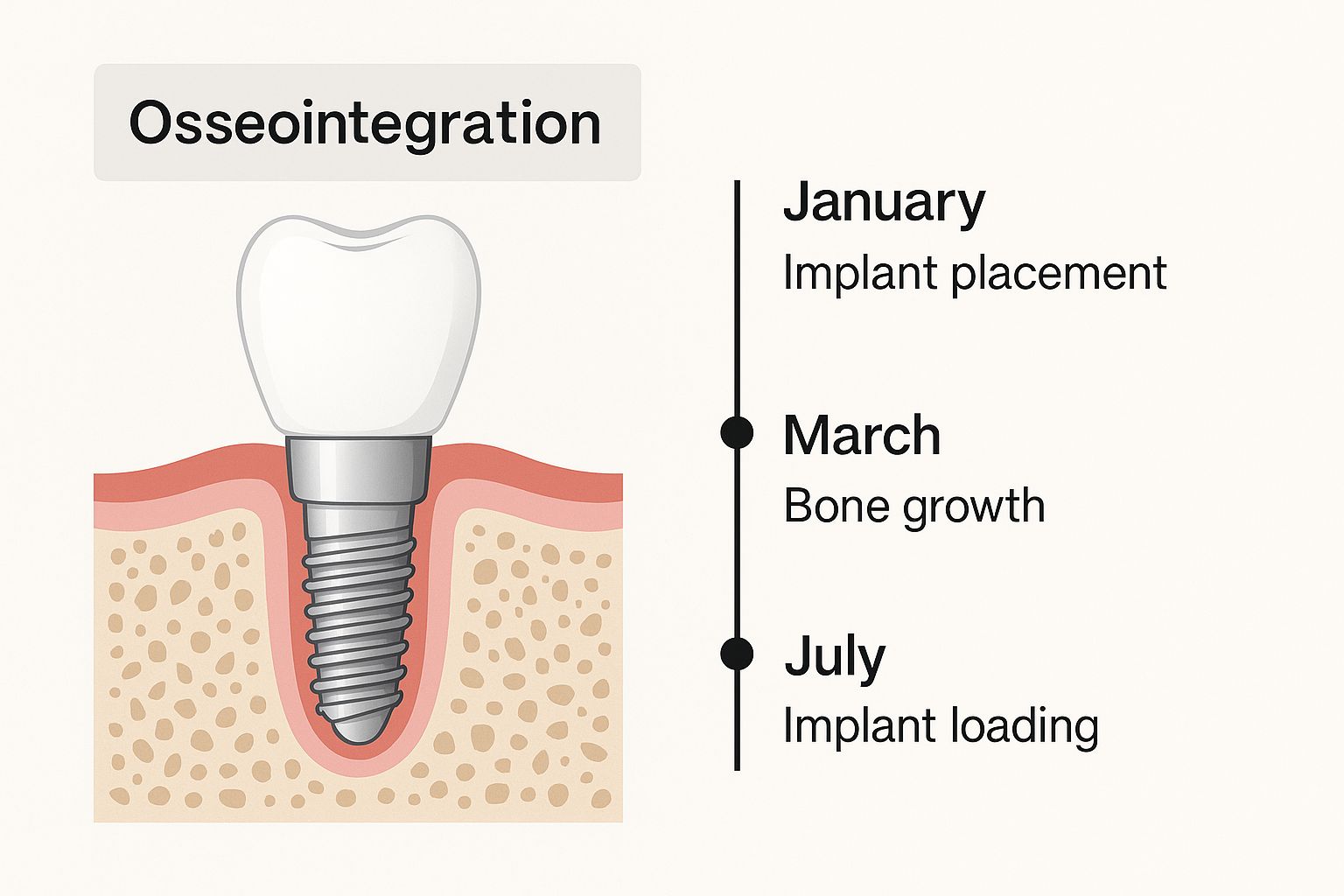
As you can see, it’s not just a surface-level connection. It’s a deep, structural integration that locks your new tooth in for good.
This “hidden healing” phase is the longest part of the journey, and you absolutely have to be patient. Osseointegration, the fusion of a dental implant with the jawbone, usually takes somewhere between 3 to 6 months. The exact timing really depends on personal factors like your bone quality and overall health. For instance, someone with great bone density might be fully fused closer to three months, while a person who needed a bone graft first will likely need more time. You can learn more about these varying healing stages on internationalplus.net.
During this period, it’s critical to avoid putting any pressure on the implant. Any top Mexico dentist will tell you this again and again. Chewing on the implant before it’s fully integrated is like wiggling a brand-new fence post before the concrete has set—you risk disrupting that delicate fusion and could even cause the implant to fail.
“Think of the osseointegration period as a quiet, protected construction phase for your new smile. Your jawbone is working hard behind the scenes to build a lifelong foundation. The best thing you can do is let it work undisturbed.”
Following your dentist’s diet and care instructions during these months is non-negotiable. This is especially true for patients who travel to Tijuana for their dental work, as you want to make sure your investment in the procedure pays off with a successful, lasting result.
Certain habits and conditions can make a huge difference in how quickly and how well your implant fuses with the bone.
Positive Influences:
Negative Influences:
Understanding this vital stage helps you see why a skilled dentist is so meticulous about planning your treatment timeline. Those quiet months of healing are what ultimately lead to a strong, stable, and confident smile that can last a lifetime.
There’s no single, universal answer to how long your dental implant healing will take. Think of it less like a rigid train schedule and more like a personal road trip—while the destination is the same, your specific route and timing will be all your own. Several key factors can either put you in the fast lane to recovery or add a few detours, and understanding them from the start helps set clear, realistic expectations.
A successful implant needs a solid foundation, just like a house. In this case, your overall health is the bedrock. Your body’s ability to heal efficiently, manage inflammation, and grow new tissue all comes down to your general wellness. The condition of your jawbone itself is, of course, another massive piece of the puzzle.
Your body’s built-in repair system is directly influenced by your health and daily lifestyle. It’s a simple truth: a patient in great health will almost always bounce back faster than someone managing underlying conditions or engaging in habits that get in the way of healing.
A good Mexico dentist will dive deep into these factors during your initial consultation. This isn’t just a formality; it’s a critical step to build a treatment plan that works with your body, not against it, whether you’re getting one implant or a complete full mouth restoration.
When it comes to healing, two factors really stand out as major obstacles: smoking and diabetes. Both can throw a wrench in the works and require extra care and attention to ensure your implant is successful.
Smoking is probably the single biggest roadblock to a smooth recovery. It constricts your blood vessels, which is like putting a clamp on the fuel line to the surgical site. This chokes off the supply of oxygen and nutrients your tissues desperately need to repair themselves and for the bone to fuse. Research shows that smokers have a 2–3 times higher risk of implant failure. You can discover more insights about recovering from dental implants on hiossen.com to see the hard data behind these risks.
Uncontrolled diabetes is another serious challenge. When blood sugar levels are high, it can impair circulation and weaken your immune system. This double-whammy makes the area more prone to infection and drags out the healing time significantly.
Finally, the scale of your dental work plays a huge role. The recovery from a single, straightforward implant looks very different from a more involved restoration.
| Procedure Type | Typical Healing Focus | Key Timeline Consideration |
|---|---|---|
| Single Dental Implant | Healing is concentrated on one specific spot. | Osseointegration is usually straightforward, taking about 3-4 months in a healthy jaw. |
| All on 4 Dental Implants | Healing happens at four strategic implant sites at once. | You get a temporary set of teeth right away, but the bone underneath still needs 4-6 months to fully lock in all four implants. |
| Full Mouth Restoration | This is the most complex scenario, often combining multiple dental implants with crowns, veneers, or bone grafts. | This requires a carefully phased approach. The timeline is the longest, often spanning 6-12 months to make sure every single component heals perfectly. |
Patients looking into extensive treatments like All on 4 dental implants in Tijuana really benefit from working with dentists who specialize in these complex cases. They know how to map out a clear, stage-by-stage plan that respects the healing time needed for each part of the restoration.
To get a feel for what might be the best fit for your own smile, you can explore our guide on the different dental implant options we offer. By understanding all these variables, you and your dentist can team up to create a treatment plan that’s both realistic and set up for success.
This is it—the final and most exciting chapter in your dental implant healing timeline. After months of your body working its magic behind the scenes, the osseointegration process is finally complete. Your implant isn’t just a post in your jaw anymore; it’s a rock-solid, permanent part of you, ready and waiting to support a beautiful new tooth.
All your patience is about to pay off. For anyone who has undergone a major transformation, like getting All on 4 dental implants or a full mouth restoration in Tijuana, this moment feels especially triumphant. Now, we move from the foundational work to the finishing touches that bring your smile back to its full, functional glory.
Before your final crown can be placed, we need to add a small but crucial connector piece called an abutment. The best way to think about it is like this: the implant is the deep, sturdy foundation, and the abutment is the framework that allows us to build the house—your new crown—on top.
To get this done, your Mexico dentist will perform a quick, minor procedure. A small incision is made in the gum tissue to reveal the top of the implant. The abutment is then screwed securely into place, and the gums are carefully shaped around it to create a natural-looking contour. Any discomfort is usually minimal and fades within a few days as your gums heal around the new component.
With the abutment ready, you’re on the home stretch. Your dentist will take incredibly precise digital impressions of your mouth, which are then sent off to the dental lab. This is where skilled technicians get to work crafting your final restoration, whether that’s a single porcelain crown, a bridge, or a full-arch prosthesis for an All on 4 dental implants case.
This is where artistry and technology really come together. Top clinics in Tijuana often have their own in-house dental labs, using sophisticated CAD/CAM technology to design and mill restorations with unbelievable accuracy. This doesn’t just guarantee a perfect fit; it ensures the color, shape, and even the subtle translucency are a perfect match for your natural teeth or new veneers.
At your final visit, the custom-made restoration is tried in. Your dentist will meticulously check the fit, your bite, and the overall look before permanently securing it to the abutment. The moment it’s locked in, your smile transformation is complete. You can finally see, feel, and use your new tooth just as you would a natural one.
Completing an All on 4 dental implants procedure is particularly rewarding, marking the culmination of a truly life-changing journey. If you’re curious about what this process involves, you can dive deeper into our in-depth guide on All-on-4 dental implants. When that final bridge is placed, it restores so much more than teeth—it brings back confidence and a whole new quality of life. Whether it was for one tooth or a full set, this final step signals the successful end of your implant journey and the start of a lifetime with a healthy, complete smile.
Getting through the dental implant healing timeline is a huge milestone. You’ve made it past the surgery and the all-important osseointegration phase. Now what? Your focus needs to shift from healing to simple, long-term maintenance. This is how you’ll make sure that beautiful new smile—and the investment you made in it—lasts for the rest of your life.
Think of your dental implants like a classic car. They’re built to go the distance, but they still need regular tune-ups to keep running smoothly. While implants themselves can’t get cavities, the gums around them are still susceptible to inflammation and infection if you don’t look after them. That’s why great daily hygiene is the absolute bedrock of long-term success.
Caring for implants is a lot like caring for natural teeth, but with a couple of important tweaks. The main goal is to keep the area around the implant post, right where it meets the gum line, totally free of plaque and bacteria. This is even more crucial for bigger restorations like All on 4 dental implants or a full mouth restoration.
Your daily routine should look something like this:
Making these simple habits part of your everyday life is the single best thing you can do to protect your gums and the jawbone holding your implants in place.
Maintaining excellent overall oral health is paramount for the long-term success and integration of your dental implants. Beyond the implant site, factors like the materials used in other dental work can also impact your systemic health; for instance, understanding the potential challenges associated with the Dangers of Mercury Tooth Fillings can be insightful.
No matter how meticulous you are with your home care, professional cleanings and check-ups are simply not optional. Visiting your Mexico dentist for routine appointments, usually every six months, gives them a chance to professionally clean your implants and spot any potential issues before they become real problems.
During these visits, your dental team in Tijuana will:
Think of these appointments as your insurance policy. They protect your investment. When you combine diligent at-home care with professional oversight, you’re setting yourself up for a healthy, functional, and gorgeous smile that can last for decades.
It’s completely normal to have a ton of questions as you navigate your recovery. You’re not alone! Below, we’ve put together some straightforward answers to the most common things patients ask us about the dental implant healing timeline, especially for those coming to see a Mexico dentist.
Patience is your best friend when it comes to your diet post-surgery. You’ll need to stick to a soft-food-only menu for the first one to two weeks. This is non-negotiable—it gives the area the protection it needs to heal properly.
After your follow-up appointment, your Mexico dentist will evaluate your healing and let you know when it’s safe to start slowly adding firmer foods back in. But even then, you have to be careful not to chew directly on the implant site for a few months. That gives the all-important osseointegration process the time it needs to work its magic, undisturbed.
This is a really important distinction. The implant post itself—the part that’s surgically placed into your jawbone—should never, ever feel loose. If you feel any movement from the post, you need to call your dentist in Tijuana right away. It could be a sign that the implant isn’t integrating with the bone correctly.
Now, what you might feel is a tiny bit of movement from the healing cap or abutment, which is the small piece attached on top of the implant. While this is less of an emergency, you should still give your dentist a call just to make sure everything is sitting exactly as it should be.
The success of your full mouth restoration or single implant all comes down to a stable, immobile post. Any wiggle from the implant itself is a red flag that needs immediate attention to protect your new smile.
Most patients are genuinely surprised by how manageable the discomfort is. The worst of it usually happens in the first three days, and people often say it’s less intense than the pain after a tooth extraction.
Your dentist will likely give you a prescription or recommend an over-the-counter pain reliever, which does a great job of managing the discomfort. Most people only need it for a couple of days right after surgery before they start feeling back to normal.
The healing journey for All on 4 dental implants is a bit different. The initial healing of your gums and soft tissues is pretty similar to a single implant, taking about one to two weeks. The real work, osseointegration, is happening below the surface. That still takes 3-6 months for the four implants to fuse permanently with your jawbone.
Here’s the big win with the All on 4 system: you walk out with a temporary, but totally fixed, set of teeth the very same day as your surgery. This means you can eat (soft foods!), speak, and smile with confidence while that critical bone fusion happens. It’s one of the biggest benefits of getting this advanced treatment from a top Mexico dentist. For more in-depth answers, you can check out our detailed article covering the top FAQs about dental implants in Tijuana.
Experience the difference of world-class dentistry in Tijuana Mexico at Trust Dental Care – your trusted partner for a radiant and healthy smile at an affordable price.